As the upcoming presidential election nears, we are hearing the usual buzzwords: “economy,” “jobs,” “health care,” but now we are forced to deal with a matter that makes many Americans uncomfortable and fidgety. That topic, of course, is race, and how our country’s racial attitudes and biases decide our future possibilities. 

To put it simply, race in America is still very complicated. For one, the president had to release his birth certificate last year in an effort to quell growing skepticism about whether he is a United States citizen. President Obama said in an interview with Rolling Stone that, “I never bought into the notion that by electing me somehow we were entering into a post-racial period.”

However, he notes that, “I’ve seen in my own lifetime how racial attitudes have changed and improved, and anybody who suggests that they haven’t isn’t paying attention or is trying to make a rhetorical point … Because we see it every day, and me being in Oval Office is a testimony to changes that have been taking place.”

What do you think about the suggestion of America as a post-racial society?  Our ongoing series “A.C.T.O.R. (A Continuing Talk on Race)” facilitates open and honest discussions about the effect of race and racialization on everyday life in America.  Check out the next A.C.T.O.R. to participate in this ongoing conversation.

It may also be helpful to think about the definitions of loaded words like ‘race’ and ‘racism’:

Nikhil Singh’s defines race as “historical repertoires and cultural and signifying systems for the purpose of another’s health, development, safety, profit or pleasure.”

Ruth Wilson Gilmore has defined racism as “the state-sanctioned or extralegal production and exploitation of group-differentiated vulnerability to premature death.” 

Race and racism will undoubtedly play a role in this upcoming election. The question is: how much of one?
The Making of Busboys and Poets

A Seat at the Table: The Making of Busboys and Poets

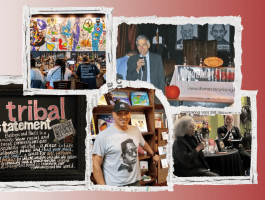
We’re proud to announce A Seat at the Table: The Making of Busboys and Poets, the new memoir from our CEO and Founder, which reveals the vision, challenges, and triumphs behind opening Busboys and Poets. Packed with misadventures, unexpected triumphs, and insights on race, business and politics, Andy Shallal’s memoir takes us on a “How I Built … Continued

PHOTO 2024 02 01 07 10 14

For Langston Hughes on His 123 Birthday

Speech given on February 1, 2024 in Havana, Cuba In 1927 Langston Hughes walked into a Cuba amid an emerging community of artists, intellectuals, and radicals.  He saw a “sunrise in a new land [– a day – in his words]sic – full of brownskin surprises, and hitherto unknown contacts in a world of color.”  … Continued

PALESTINE WEEK 1920 x 1080 px 2

Palestine Week 2024

January 18, 2024 – January 25, 2024 In keeping with our ongoing mission of uplifting racial and cultural connections, Busboys and Poets is hosting Palestine Week (January 18 through January 25, 2024). This week-long series of events will offer a diverse range of programming featuring Palestinian food, music, dance, poetry, discussions, and other enriching events. … Continued

SPPC Header11

The Ward 8 World’s Greatest Sweet Potato Pie Contest

The Ward 8 World’s Greatest Sweet Potato Pie Contest at Busboys and Poets Anacostia encourages Ward 8 residents to share their amazing baking skills and tasty treats with the community and Busboys and Poets tribe. Each entrant will receive a $50 Busboys and Poets Giftcard 10 Semi-finalists will receive a $100 Cash Prize  5 Finalists will receive a $250 Cash Prize The grand prize winner will receive a $1000 cash prize and … Continued

HanvanaLunch byJamesAlbright

4. Cuba – The Hotel Nacional

Follow along for the Busboys and Poets Travel Tribe’s Cultural Exchange trip to Cuba (July 6-13, 2022) Wednesday, July 6, 2022 By Andy Shallal (@andyshallal CEO/Founder, Busboys and Poets) On the way to the hotel we make a pit stop for lunch. A sprawling thatch covered restaurant. Completely open to the elements on all sides. Linen … Continued

On Censorship by Salman Rushdie

On Censorship by Salman Rushdie

No writer ever really wants to talk about censorship. Writers want to talk about creation, and censorship is anti-creation, negative energy, uncreation, the bringing into being of non-being, or, to use Tom Stoppard’s description of death, “the absence of presence.” Censorship is the thing that stops you doing what you want to do, and what writers want to talk about is what they do, not what stops them doing it.