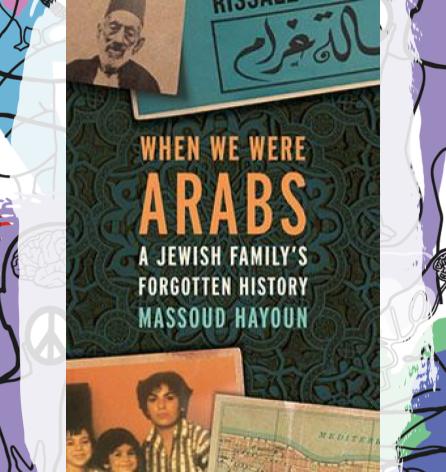
Busboys Books Presents: When We Were Arabs by Massoud Hayoun
Date and Time
Jul 8, 2019 6:30 pm
Location
14th & V
2021 14th St NW, Washington, District of Columbia, 20009
Jul 8, 2019 6:30 pm
14th & V
This is a free event open to the public. Seats are first come, first served. We will have copies of When We Were Arabs available in the bookstore for purchase before and after the book signing. Full menu and bar will be available for purchase throughout the event. Massoud Hayoun will be in conversation with D. Parvaz. This event is being co-sponsored by the Middle East Institute.
The stunning debut of a brilliant nonfiction writer whose vivid account of his grandparents’ lives in Egypt, Tunisia, Palestine, and Los Angeles reclaims his family’s Jewish Arab identity
“I am Arab, I am Bedouin
And I am a daughter of the Arabs!”
—“Daughter of the Arabs,” performed by Jewish Tunisian singer Louisa Saadoun (known as Louisa Tounsia/Louisa the Tunisian), from a record released in 1961
There was a time when being an “Arab” didn’t mean you were necessarily Muslim. It was a time when Oscar Hayoun, a Jewish Arab, strode along the Nile in a fashionable suit, long before he and his father arrived at the port of Haifa to join the Zionist state only to find themselves hosed down with DDT and then left unemployed on the margins of society. In that time, Arabness was a mark of cosmopolitanism, of intellectualism. Today, in the age of the Likud and ISIS, Oscar’s son, the Jewish Arab journalist Massoud Hayoun whom Oscar raised in Los Angeles, finds his voice by telling his family’s story.
To reclaim a worldly, nuanced Arab identity is, for Hayoun, part of the larger project to recall a time before ethnic identity was mangled for political ends. It is also a journey deep into a lost age of sophisticated innocence in the Arab world; an age that is now nearly lost.
When We Were Arabs showcases the gorgeous prose of the Eppy Award–winning writer Massoud Hayoun, bringing the worlds of his grandparents alive, vividly shattering our contemporary understanding of what makes an Arab, what makes a Jew, and how we draw the lines over which we do battle.
Massoud Hayoun is a journalist based in Los Angeles, most recently freelancing for Al Jazeera English and Anthony Bourdain’s Parts Unknown online while writing a weekly column on foreign affairs for Pacific Standard. He previously worked as a reporter for Al Jazeera America, The Atlantic, Agence France-Presse, and the South China Morning Post and has been published widely. He speaks and works in five languages and won a 2015 EPPY Award. The author of When We Were Arabs: A Jewish Family’s Forgotten History (The New Press), he lives in Los Angeles.
D. Parvaz is the Global Politics Reporter at ThinkProgress, based in Washington, DC. She previously worked as a senior producer at Al Jazeera based out of New York and Doha, focusing on human rights and conflict. She was also digital special projects editor for the network, where she crafted spotlight coverage on key stories and reported on political issues and democracy in several countries, including Egypt, Libya and Afghanistan.
Founded in 1946, the Middle East Institute is the oldest Washington-based institution dedicated solely to the study of the Middle East. It is a non-partisan think tank providing expert policy analysis, educational and professional development services, and a hub for engaging with the region's arts and culture. MEI’s Arts & Culture Center facilitates cross-cultural understanding by promoting the work of Middle Eastern artists, hosting them in conversation, and connecting them with American counterparts.On September 14, MEI is excited to launch the MEI Art Gallery in its newly renovated headquarter with its first show "Arabicity|Ourouba." The exhibition, curated by Rose Issa, will explore the aesthetic, conceptual, and socio-political concerns of the Arab world over the past twenty years as expressed by its leading artists. The show will feature works by 18 artists, including Chant Avedissian, Ayman Baalbaki, Hassan Hajjaj, Susan Hefuna, Taghreed Dargouth, Adel Abidin, Raeda Saadeh, and Mohamad Said Baalbaki.